OpenClaw Tech Roadmap 2026: Architecture Rewrites, Protocol Standards, Security Hardening
OpenClaw Tech Roadmap 2026: Architecture Rewrites, Protocol Standards, Security Hardening
Source: https://x.com/lijiuer92/status/2023355272542998796 Author: @lijiuer92 Published: 2026-02-16
OpenClaw's technical evolution is happening on three fronts simultaneously: architecture rewrites, protocol standardization, and security hardening.
Bottom line: OpenClaw's biggest technical risk isn't competitors — it's its own growing pains.
Three key conclusions:
- PicoClaw (Go rewrite, <10MB RAM) and ZeroClaw (Rust rewrite, 3MB binary) are redefining what it takes to run an AI agent — from a $399 Mac Mini to a $10 dev board
- The MCP protocol has been donated to the Linux Foundation's AAIF; agent protocol standardization is entering a convergence phase
- OpenClaw's real moat isn't performance — it's the composability of a 3,000+ skill ecosystem
Part 1: Architecture Evolution — From Node.js to Multi-Language Rewrites
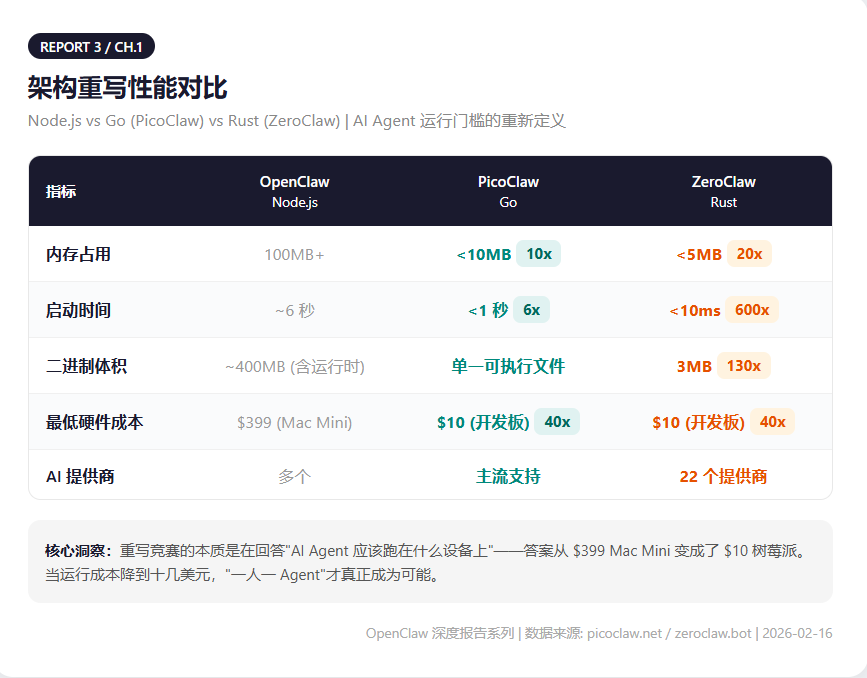
OpenClaw is a Node.js application. Going from zero to 200K stars in 60 days, that was a completely reasonable technical choice. But Node.js limitations become visible at scale: typical instances use 100MB+ RAM, take ~6 seconds to start, and performance degrades sharply after 200K tokens.
PicoClaw (Go rewrite): 95% of core code was self-generated by AI agents. The biggest breakthrough isn't speed — it's deployment simplicity. No Node.js dependency, no Docker, copy one executable to the target device and run. Can even run on a $10 RISC-V dev board.
ZeroClaw (Rust rewrite): security-first design philosophy. 3MB binary, <5MB RAM, <10ms startup, supports 22 AI providers.
When running cost drops from hundreds of dollars to tens: every family member gets their own dedicated agent, small businesses put an agent next to the cash register, users in developing countries are no longer excluded by hardware requirements.
The challenge: 3,000+ skills were built for Node.js. Ecosystem migration may be harder than the technical rewrite.
Part 2: Security Architecture — From Exposed to Defense in Depth
The numbers are worse than most people realize:
- Aikido audit: 26% of 31,000 skills have vulnerabilities (double the 12% the community self-reported)
- SecurityScorecard: 135,000+ instances exposed to the public internet
- v2026.2.12 patched 40+ vulnerabilities
Four-layer security toolchain:
- Skill scanning (pre-install): skill-scanner, Cisco Scanner
- System audit (runtime): clawsec-suite, audit-watchdog
- Continuous monitoring (ongoing): clawsec-feed CVE monitoring, soul-guardian
- Network isolation (infrastructure): Docker sandbox, Tailscale zero public ports
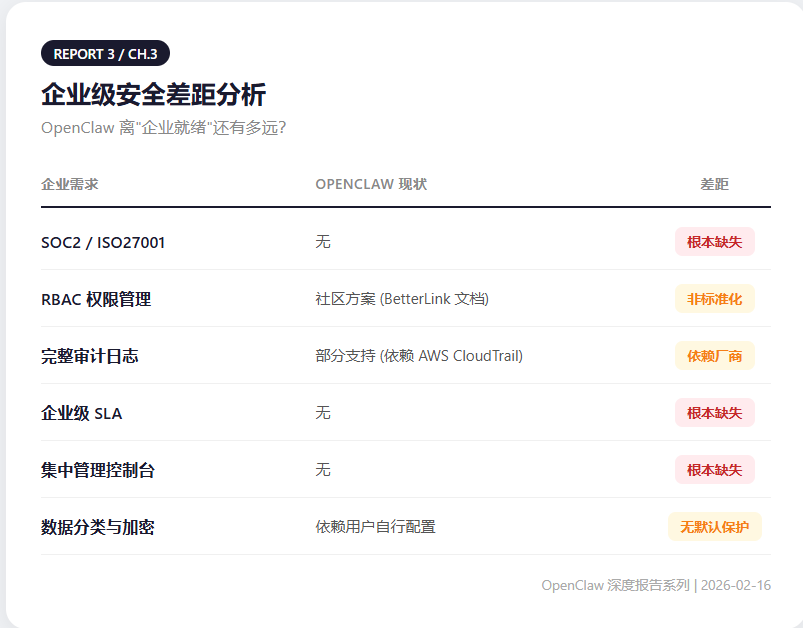
The enterprise security gap is clear: SOC2/ISO27001 completely absent, RBAC non-standardized, no centralized management console. Whoever builds "enterprise-grade OpenClaw" first gets the B2B market entry ticket.
Part 3: Competitive Landscape — Layered Competition
This isn't one battlefield — it's three:
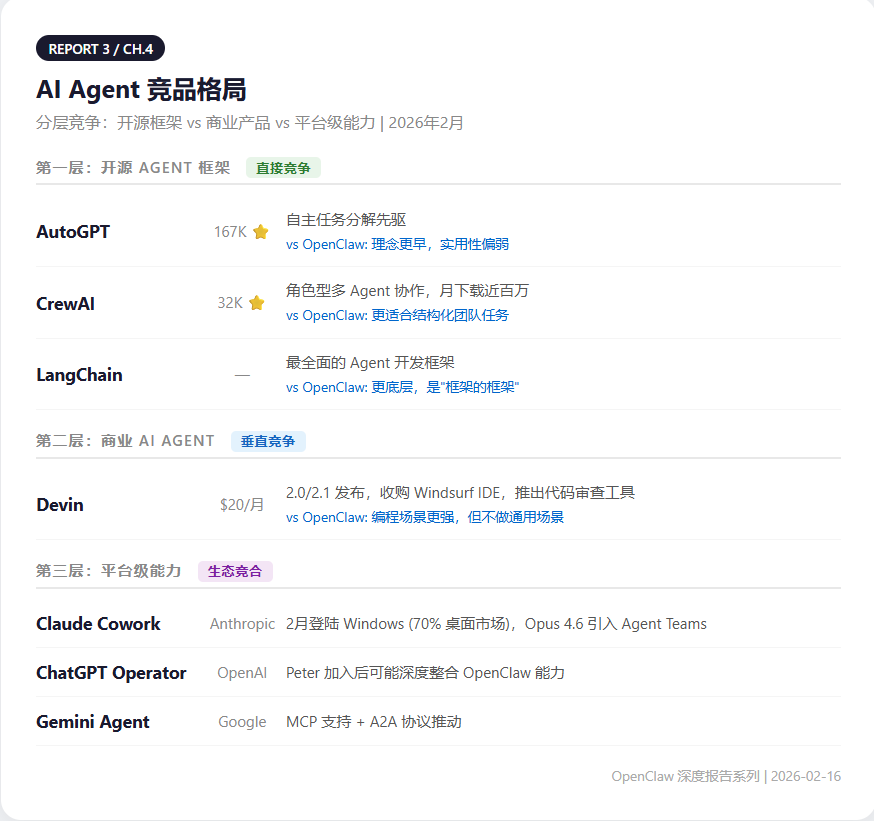
Layer 1: Open-source agent frameworks (direct competition) AutoGPT (167K stars) had the idea earlier but weaker practical utility. CrewAI has nearly a million monthly downloads but lacks a skill ecosystem. LangChain is more foundational — a "framework for frameworks."
Layer 2: Commercial AI agents (vertical competition) Devin goes deep on the coding vertical. OpenClaw isn't as good as Devin at coding, but it vastly outperforms Devin in general-purpose scenarios.
Layer 3: Platform-level capabilities (ecosystem coopetition) Claude Cowork lands on Windows (70% of the desktop market). ChatGPT Operator may integrate OpenClaw capabilities.
OpenClaw's real moat: composability
- Skills compose: 3,000+ plugins mix and match freely
- Platforms compose: connect Discord/Telegram/iMessage/WhatsApp/Slack simultaneously
- Models compose: Claude/GPT/Gemini/Ollama/DeepSeek — no LLM lock-in
Composability = users don't get locked in. That's hard for commercial competitors to replicate.
Part 4: Protocol Standardization and Foundation Governance
MCP: Anthropic donated MCP to the Linux Foundation's AAIF. OpenAI's AGENTS.md and Block's goose joined as founding projects. Three major AI competitors collaborating under the same foundation to set standards — a first for the industry.
A2A: Google-led agent-to-agent communication standard. BeeAI/IBM's ACP has merged with A2A and is becoming the de facto standard.
Protocol standardization is a major tailwind for OpenClaw: 3,000+ skills become usable by other MCP agents, A2A makes cross-agent collaboration more reliable, and Linux Foundation backing reduces enterprise adoption risk.
Part 5: Market Outlook
The AI agent market grows from $7.84B to $52.62B by 2030. Gartner predicts 40% of enterprise applications will include AI agents by end of 2026.
OpenClaw is positioned at the center of an exploding market. Whether it can convert GitHub stars into community momentum, a security track record, and enterprise maturity will determine its final share of that $50B+ market.
Original post: https://x.com/lijiuer92/status/2023355272542998796 | via @lijiuer92